Source Analysis – The “70% Basij” Claim: How a Provincial Recruitment Goal Became a Nationwide Statistic
By Unheard Conscripts Advocacy Network

Purpose of this Analysis
The Unheard Conscripts Advocacy Network (UCAN) has prepared this analysis to examine a widely repeated claim concerning Basij membership among individuals assigned to the Islamic Revolutionary Guard Corps (IRGC) to fulfill their mandatory service.
At the centre of this analysis is a claim that “since 2010 more than 70 percent of draftees in the IRGC have been active members of the Basij.” This assertion appeared in Saeid Golkar’s 2019 study, The Supreme Leader and the Guard, and was subsequently repeated in a January 2023 Foreign Policy article that he co-authored with Kasra Aarabi.
The assertion has since circulated through policy analyses, country-information materials, and parliamentary discussions.
In Canadian immigration proceedings, claims of this nature may be used to draw inferences about an individual former conscript’s alleged Basij membership, voluntary affiliation with the IRGC, or ideological association with the organization. When unsupported by individualized evidence, such inferences may contribute to serious immigration consequences, including findings of inadmissibility.
This analysis examines the original Persian-language source, identifies how its meaning and scope differ from subsequent English-language interpretations, and evaluates the evidentiary limitations of the broader claim.
This analysis does not seek to assess the individual circumstances of any immigration applicant. It provides the relevant source material for independent examination by immigration decision-makers, legal representatives, parliamentarians, and affected individuals.
1. The Claim as It Is Commonly Presented
A widely cited English-language assertation states:
“Since 2010 more than 70 percent of draftees in the IRGC have been active members of the Basij.”
The statement presents four distinct propositions:
- More than 70 percent of the individuals concerned were Basij members.
- The figure applies to IRGC conscripts generally.
- They were active members of the Basij.
- The asserted pattern has existed since 2010.
None of these propositions, in their combined form, is established by the original Persian-language passage examined below.
2. The Original Persian Statement
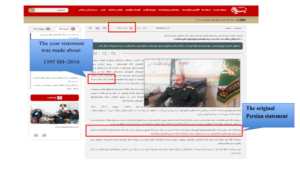
The underlying Persian-language statement, published in 2016, reads:
وی ادامه داد: سعی ما در سپاه ولیعصر(عج) خوزستان بر این است که 70 درصد سربازان خود را از طریق بسیجیانی جذب کنیم…
English Translation
“He continued: Our effort in the Vali-Asr (AJ) Corps of Khuzestan is to recruit 70 percent of our conscripts through Basij members…”
A screenshot of the original Persian-language source is provided at the end of this analysis.
The key terms identifying the organizational scope, recruitment objective, and recruitment channel are examined separately in Section 3.
3. What the Original Statement Actually Says
The original Persian-language statement differs materially from the later English-language formulation.
3. A The Geographic and Organizational scope is Limited
The phrase:
“در سپاه ولیعصر(عج) خوزستان”
refers specifically to the Vali-Asr (AJ) Corps of Khuzestan, a provincial IRGC corps.
The statement is geographically and organizationally limited to a specific provincial corps. Extending its scope to all IRGC conscripts nationwide would require independent supporting evidence.
3. B. A Recruitment Objective Is Not an Established Statistic
The original Persian-language statement uses the phrases:
“سعی ما … بر این است”
This means, in substance, “our effort is,” “we strive to,” or “our aim is.”
The wording expresses an aspirational recruitment target rather than a measured outcome. It provides no evidence that the target was achieved or that the stated percentage represents actual historical statistics.
“Our effort is to recruit 70% of our conscripts through Basij members.”
It does NOT state:
70% of our conscripts are Basij members.
Nor does it establish that 70% of conscripts actually recruited through that unit were active Basij members.
This distinction is particularly important when the original statement is later used as statistical evidence of actual Basij membership.
3. C. The Original Statement Does Not Mention 2010
The Persian-language statement was published in 2016. It contains no reference to 2010 or any earlier period.
However, the later formulation:
“Since 2010…”
Accordingly, the timeframe introduced in the later English-language claim cannot be established from this passage alone.
3. D. Recruitment Through Basij Members Does Not Establish Basij Membership
The original Persian-language statement describes an effort to recruit conscripts “through Basij members.”
The phrase describes a recruitment channel, not necessarily the membership status of the individuals. Recruiting through Basij members does not, by itself, establish that those conscripts were active Basij members.
4. How the Statement Was Subsequently Transformed
The later English formulation changes several important elements of the original Persian statement:
| Original Persian statement | Later English formulation |
| Vali-Asr (AJ) Corps of Khuzestan | IRGC generally |
| A specific provincial unit | Nationwide/general IRGC scope |
| “Our effort is to recruit” | “More than 70 percent … have been” |
| Recruitment objective | Historical membership statistic |
| No reference to 2010 | “Since 2010” |
| “Through Basij members” | “Have been active members of the Basij” |
Collectively, these changes transform a localized recruitment objective into a broader historical assertion that the original passage does not independently substantiate.
5. Why This Matters in Immigration Proceedings
Country-of-origin information may be used in individual immigration proceedings to assess alleged affiliations with the IRGC or Basij.
When a generalized claim is presented as an established fact, it may influence how an individual’s circumstances of mandatory service are interpreted.
For example, reliance on the broader “70% Basij” claim could contribute to the following chain of assumptions:
More than 70% of IRGC conscripts were active Basij members”
↓
An individual assigned to the IRGC was likely an active Basij member.
↓
The individual likely had a prior ideological affiliation with the IRGC or Basij.
↓
The individual’s mandatory service may have reflected voluntary or ideological involvement rather than compulsory assignment.
↓
The individual may be regarded a member of the IRGC.
↓
This may contribute to a finding of inadmissibility under section 34(1)(f) of the Immigration and Refugee Protection Act (IRPA).
This is an illustrative chain of possible inferences, not an established description of how immigration officers assess these cases or a statement of the legal test for inadmissibility.
The original statement cannot independently substantiate this chain of assumptions. Any conclusion concerning an individual’s membership, voluntary involvement, or ideological affiliation requires evidence specific to that person and an appropriate legal assessment.
6. The Citation Chain
The claim’s repetition across multiple publications raises concerns about independent corroboration. Examining the citation chain is essential to determine whether these publications provide independent evidence or simply repeat the same original source.
The apparent chain is:
2016 — Original Persian-language statement: A recruitment objective concerning the Vali-Asr (AJ) Corps of Khuzestan
↓
2019 — Golkar, The Supreme Leader and the Guard
A broader assertion concerning Basij membership among IRGC conscripts.
↓
2023 — Golkar & Aarabi, Foreign Policy
The assertion that, since 2010, more than 70% of IRGC draftees have been active Basij members.
↓
Subsequent policy publications
Repetition or incorporation of the claim
↓
Canadian parliamentary discussions and country-information materials.
Further discussion or reliance on the claim
↓
2026 — UK Home Office
Country information concerning Iranian mandatory service and IRGC conscription.
Repetition across publications should not be mistaken for independent corroboration where the underlying evidentiary basis remains the same.
7. Canadian Immigration Context
In a 2022 Response to Information Request (RIR), the Immigration and Refugee Board of Canada (IRB) Research Directorate cited information provided by Saeid Golkar indicating that most individuals assigned to the IRGC for compulsory service were active Basij members.
However, the Research Directorate also stated that it was unable to find corroborating information for this assertion among the sources consulted within the time constraints of its response.
The inclusion of this assertion in an official country-information document should therefore not be interpreted as independent verification of its accuracy.
This does not, in itself, resolve the broader factual question concerning Basij recruitment or membership. It highlights the distinction between an expert assertion and corroborated evidence when assessing an individual immigration case.
8. The Importance of Examining the Original Source
UCAN does not suggest that the original Persian-language statement has no evidentiary value. Rather, the issue is the extent to which that statement can reasonably support conclusions that go beyond its actual wording and context.
Before relying on the “70% Basij” claim, the following evidentiary considerations should be addressed:
- Source authority: The identity, position, and scope of knowledge of the original speaker.
- Organizational scope: The geographic and institutional limits of the statement.
- Statistical reliability: Whether the figure represents an objective, estimate, or verified outcome.
- Temporal basis: The origin and supporting evidence for the alleged 2010 starting point.
- Linguistic accuracy: Whether subsequent interpretations accurately reflect the original Persian wording.
- Independent corroboration: Whether later publications provide new evidence or repeat earlier assertions.
- Individual applicability: Whether evidence specific to the applicant supports conclusions concerning Basij membership, voluntary involvement, or ideological affiliation.
These considerations are essential to distinguishing generalized country information from evidence capable of supporting findings about an individual applicant.
9. Conclusion
The evidence identified in this analysis indicates a substantial difference between the original Persian-language statement and the broader claim subsequently attributed to it.
The original source describes a provincial recruitment objective, not a verified nationwide membership statistic. The later claim introduces additional assumptions concerning actual recruitment outcomes, active Basij membership, geographic scope, and historical timeframe that are not established by the quoted passage.
UCAN therefore respectfully recommends that immigration decision-makers, legal representatives, parliamentarians, and other stakeholders examine the original Persian-language source alongside the later English-language formulation before relying upon the “70% Basij” claim as evidence of an individual’s Basij membership, voluntary IRGC affiliation, or ideological association.
Accurate interpretation and independent corroboration are particularly important where such claims may influence immigration decisions affecting former conscripts and their families.
References
- The Supreme Leader and the Guard — Saeid Golkar, 2019
- Foreign Policy — Golkar & Aarabi, January 30, 2023
- Atlantic Council — IranSource analysis
- Canadian Parliament — Foreign Affairs Committee evidence, June 12, 2024
- UK Home Office — Iran: Military Service, August 26, 2026
- Immigration and Refugee Board of Canada — Responses to Information Requests, IRN200614.E
Original Persian-language Source
Screenshot of the original Persian-language statement