Unintended Consequences of the IRGC Listing
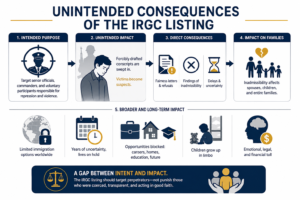 Canada’s designation of the IRGC was intended to target senior officials, commanders, and voluntary participants responsible for repression and violence. In practice, however, its current application has unintentionally swept in former conscripts, individuals who were forcibly drafted and are themselves victims of the regime.
As a result, many former conscripts now face procedural fairness letters, refusals, findings of inadmissibility, and prolonged processing delays, despite having no record of voluntary involvement or wrongdoing.
The consequences extend far beyond the individual applicant. Inadmissibility affects entire families, including spouses and even children, placing them under sustained legal, emotional, and financial pressure. Being labelled as a potential terrorism affiliate carries serious and lasting repercussions, effectively closing off immigration pathways not only in Canada but also limiting opportunities in other countries.
Years of unresolved applications and uncertainty prevent families from planning their futures, blocking job promotions, home ownership, further education, and long-term stability. Lives remain on hold while children grow up in limbo and families struggle under the weight of an unintended policy outcome.
These harms are not incidental. They stem from a gap between the intent of the IRGC listing and its real-world application, which continues to penalize individuals who were coerced, transparent, and acting in good faith.