Application Refusals & Inadmissibility Rulings
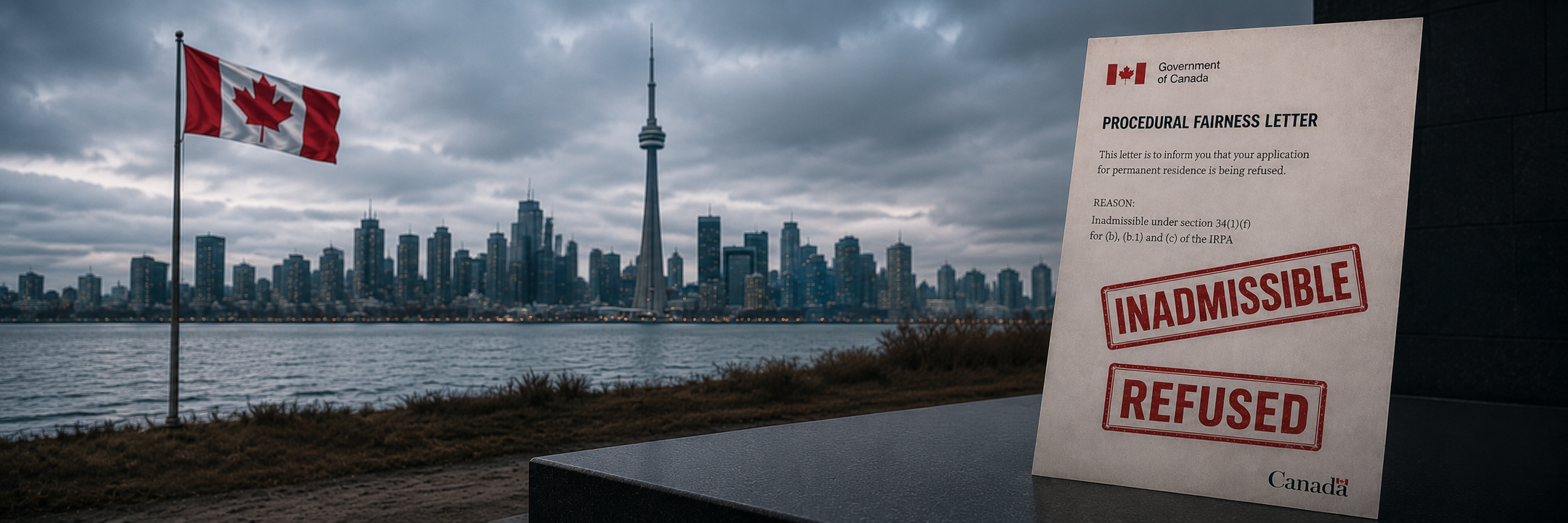
Former conscripts of the Islamic Revolutionary Guard Corps (IRGC) face severe and ongoing immigration challenges due to policies that treat compulsory conscription as equivalent to voluntary membership. As a result, individuals are exposed to inadmissibility findings, visa denials, work permit refusals, and study permit rejections, despite having had no choice in their assignment.
After the IRGC was officially listed in June 2024, Canadian officials initially indicated that forcibly conscripted individuals would not be targeted. However, a troubling pattern soon emerged. Former conscripts began receiving Procedural Fairness Letters (PFLs) warning of likely refusal and inadmissibility, based solely on their mandatory service, which many had openly and honestly disclosed in their applications.
Applicants reasonably believed that submitting supporting documents and detailed explanations would resolve concerns. Yet the Federal Court decision in Vadiati v. Canada Vadiati v. Canada (Citizenship and Immigration), 2024 FC 1056 (CanLII – https://canlii.ca/t/k5n5j) confirmed a far more alarming reality. In that case, the Court upheld inadmissibility based purely on mandatory conscription, effectively equating forced service with membership.
What makes this outcome especially shocking and unfair is its automatic extension to family members. A finding of inadmissibility does not remain confined to the individual; spouses and children can also become inadmissible by association. Innocent family members, who had no involvement, no benefit, and no agency, are labeled and penalized alongside the conscript.
Additional reported cases reveal similarly harsh treatment at ports of entry. Some individuals who had fully disclosed their conscription and were issued visas have faced intense scrutiny upon arrival at Canadian airports. Reports include interrogations lasting 3–5 hours, confiscation of passports and identification, and denial or withholding of work permits despite prior approval. In certain cases, individuals have remained in prolonged limbo for over a year – unable to work, study, or travel – while living under constant uncertainty.
The breadth and severity of these consequences demonstrate how a policy applied without individualized assessment can derail lives. A framework that conflates compulsory service with voluntary affiliation does not merely deny applications, it disrupts entire families, imposes inherited stigma on children, and creates long-term barriers for individuals who were themselves subject to mandatory conscription with no meaningful choice.